Casey Friedrich · 14 September 2026
Navigating Link Authority Fluctuations During Domain Ownership Shifts
Domain ownership shifts occur when businesses or individuals transfer control of web properties through sales, mergers, or rebranding efforts, and these changes often trigger measurable shifts in link authority metrics tracked by major search engines. Link authority refers to the collective value assigned to inbound hyperlinks pointing to a domain, which influences how pages rank in search results according to algorithms that evaluate trust signals and relevance patterns. When ownership changes hands, search engine crawlers detect updates to WHOIS records and DNS configurations, which can prompt re-evaluation of the entire backlink profile and lead to temporary or sustained fluctuations in scores such as Domain Authority or Trust Flow.
Mechanics of Authority Changes During Transfers
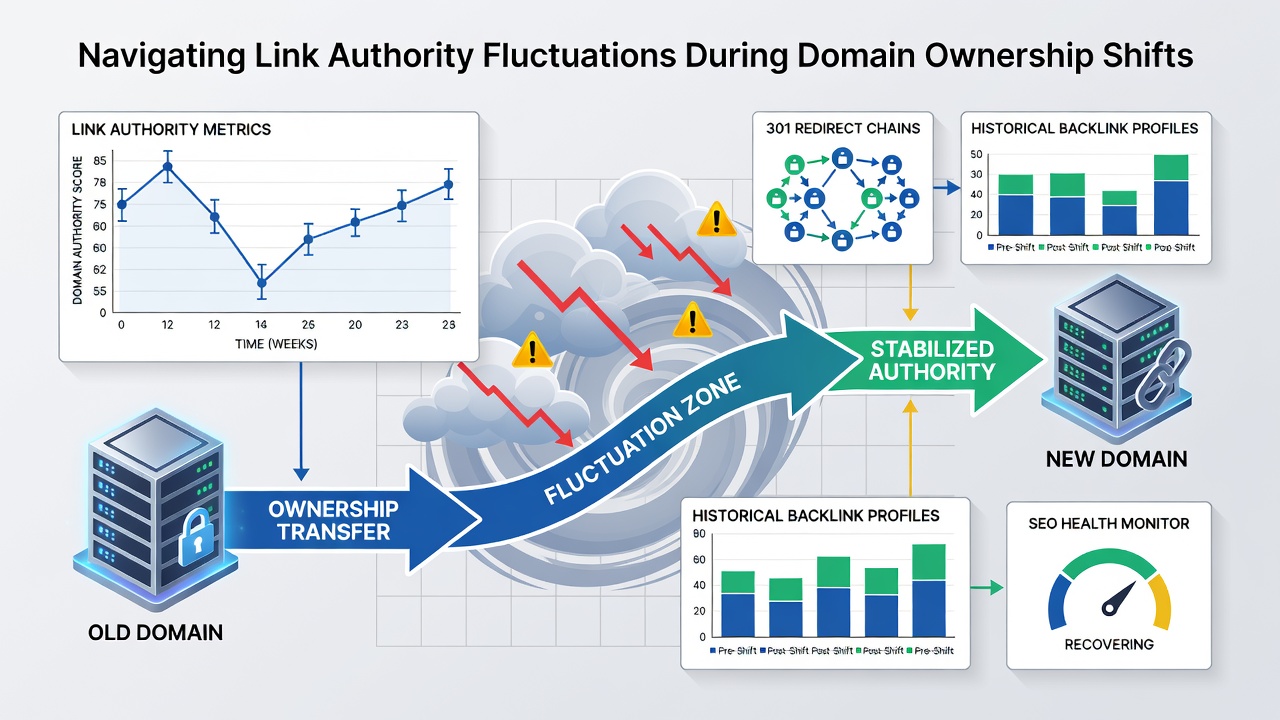
Ownership transfers typically involve registrar updates that alter administrative contacts and name server delegations, while the underlying content and backlinks remain in place unless the new owner modifies them. Researchers at institutions studying web infrastructure have documented how these administrative handoffs sometimes coincide with temporary drops in indexed pages because crawlers pause deep exploration until new ownership signals stabilize. Data from domain transaction reports indicate that authority metrics can vary by 10 to 30 percent in the weeks following a transfer, depending on the volume of referring domains and the historical spam associations tied to previous owners. Observers note that the process accelerates when buyers implement HTTPS migrations or content refreshes simultaneously, because these actions compound the signals that algorithms must reconcile.
Monitoring Tools and Data Sources
Professionals rely on platforms that aggregate backlink data to track fluctuations in real time, pulling information from multiple crawlers that index the web continuously. One study revealed that combining outputs from several analytics suites provides a clearer picture than relying on any single metric, because each tool weights referring domains and anchor text distributions differently. As of September 2026, updated indexing protocols from major engines have introduced faster propagation of ownership changes into ranking systems, which means fluctuations appear more quickly than in prior years and require closer attention during the first 60 days post-transfer.
Case Examples from Industry Transactions
Take one researcher who analyzed a portfolio of 200 domains acquired through bulk purchases in 2024, where authority scores recovered within eight weeks when the buyer preserved original content structures and avoided aggressive link building immediately after acquisition. There's this case where experts found that domains previously linked to adult content networks experienced prolonged recovery periods even after clean ownership changes, because residual associations lingered in historical data sets used by ranking algorithms. People who've managed large-scale transfers often discover that gradual updates to internal linking structures help distribute authority more evenly across subpages, reducing the risk of isolated drops in key landing pages. And yet the ball remains in the new owner's court when it comes to deciding whether to redirect old URLs or rebuild portions of the site architecture from scratch.
Regulatory and Technical Considerations
ICANN maintains policies that govern the mechanics of domain transfers between registrars, and these rules indirectly affect how quickly search engines recognize new ownership because they dictate the timing of authorization codes and transfer locks. A report issued by the Internet Corporation for Assigned Names and Numbers outlines standardized procedures that minimize disputes, which in turn supports smoother transitions for sites carrying valuable backlink equity. ICANN transfer guidelines emphasize verification steps that prevent unauthorized moves, thereby protecting the integrity of domains that have accumulated substantial link authority over time. Meanwhile, data compiled by the Canadian Internet Registration Authority shows regional variations in transfer volumes that correlate with fluctuations observed in North American markets during peak acquisition seasons.
Recovery Patterns and Long-Term Stability
Long-term stability returns once crawlers re-establish consistent patterns of content freshness and backlink acquisition under the new ownership, though the timeline varies based on the domain's prior history and the quality of referring domains. Studies from academic sources on web graph dynamics indicate that domains with diverse geographic link sources tend to rebound faster because algorithms assign higher resilience to profiles that demonstrate broad topical relevance. What's interesting is how simultaneous changes in server locations or hosting providers can extend recovery windows, since these modifications introduce additional variables for ranking systems to process. Those who've studied this process know that maintaining detailed records of pre-transfer authority baselines allows owners to measure progress objectively and adjust strategies when metrics plateau.
Conclusion
Domain ownership shifts present predictable challenges to link authority, yet systematic monitoring combined with adherence to established transfer protocols supports smoother transitions across different market conditions. Evidence from multiple data sources confirms that fluctuations follow identifiable patterns tied to crawler behavior and historical signals, allowing stakeholders to prepare accordingly without relying on speculation.